
Spider identification for beginners: shapes and marks
Most spiders move too fast for a long look, but their basic shapes and marks can tell you more than you might think. You do not need a microscope or a field degree to make a useful first identification. With a little practice, noticing silhouettes, leg styles, and simple color patterns can help you recognize major spider groups and avoid confusing harmless species with those that deserve more caution.
Reading the Spider’s Outline: Basic Body and Leg Shapes
The first thing to notice is the overall outline, or “body plan,” of the spider. From a beginner’s point of view, you can ignore fine details and focus on just two main body parts: the front section (cephalothorax) and the abdomen. Ask yourself how big each part looks compared with the other, and how the legs are arranged around them. This quick scan already narrows your options dramatically and helps you sort a mysterious spider into a familiar category.
Many common house and yard spiders have a “classic” outline, with a modest front section and a larger, oval abdomen attached like a bean on a plate. If the spider looks roughly symmetrical from front to back, with legs radiating evenly, you are probably looking at an orb-weaver, cobweb spider, or similar web-builder. These often sit in webs with their legs gently arched, never far from an escape route. In contrast, active hunting spiders such as wolf spiders or jumping spiders tend to look more compact and muscular, with the front section relatively large and powerful.
Leg proportions are another quick clue. Long, threadlike legs relative to a tiny body often signal cellar spiders or other delicate web-builders that hang upside down in messy webs. Thick, sturdy legs that look built for sprinting are more typical of wolf spiders and some crab spiders. Jumping spiders have noticeably short, robust legs, with front pairs that may look slightly heavier, giving them a poised, spring-loaded stance. When you combine body size, leg style, and how the spider holds itself—crouched, spread, or upright—you already have a strong starting point for identification.
Recognizing Major Shape Types in Common Spiders
Orb-weavers and Their Round or Spiny Abdomens
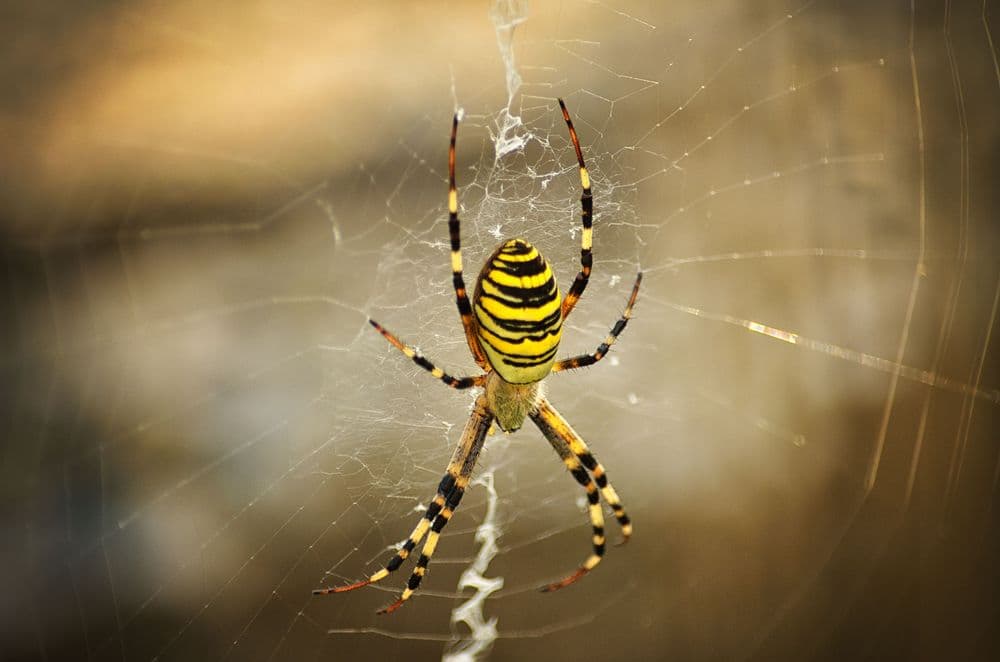
Orb-weavers are among the easiest spiders for beginners to recognize by shape alone. They typically have a rounded, often high-standing abdomen that can appear almost spherical or slightly egg-shaped when seen from the side. The front section is small in comparison, and the legs are medium to long, ideal for reaching across their flat, wheel-shaped webs at night or in the evening. When resting in the center of a web, many orb-weavers tuck their legs together, forming a neat, compact silhouette.
Some orb-weavers go beyond simple roundness and develop pointed or spiny abdomens. These spiders may show distinct “shoulders,” horn-like bumps, or angular flares that break up the smooth outline. If you see a spider with a prominent, sidewalk-chalk-style wheel web and a belly that looks like a little shield, star, or spiky ball, you are almost certainly dealing with an orb-weaver. Color varies widely—green, brown, orange, or patterned—but the combination of rounded or spiky abdomen plus classic wheel web is a reliable beginner’s marker.
The location of the web also supports your shape-based guess. Big, round orb-weavers often string webs between shrubs, porch posts, or across paths, while smaller species may decorate garden stakes and window frames. When you spot a spider in a tidy wheel of silk at dusk, its characteristic body shape and posture in the center are key identification tools before you even consider fine markings.
Jumping spiders: Compact, Front-Facing Hunters
Jumping spiders are perfect subjects for beginners learning spider shapes. They are compact, thick-bodied, and often appear almost square from above, with a broad front section that seems to dominate the body plan. Their legs are relatively short and stout rather than long and spindly, giving them a sturdy, athletic look, like tiny weightlifters rather than dancers. Many individuals move in quick bursts, stopping to pivot and inspect you, which immediately sets them apart from slow, web-bound spiders.
A hallmark feature of jumping spiders is the strongly front-focused “face.” While you may not count eyes without magnification, you can usually see a pair of oversized front eyes when you are close enough. This creates a clear directionality: there is a visible “front” that looks at you, not just a nondescript round blob. When the spider turns to track your movements with its face, you have an additional behavioral cue that matches its compact shape.
Color and marks vary widely in this family, from velvety black bodies with subtle stripes to metallic greens and iridescent patterns. However, beginners should rely first on body proportions: short, solid legs, a wide, somewhat boxy front body, and an alert stance with the front end often slightly raised. These shape cues remain consistent across many jumping spider species and provide a robust framework for early identification.
Crab spiders and Sideways Silhouettes
Crab spiders are named for a clear and easily observed trait: their sideways, crab-like build. Their front two pairs of legs are usually longer and thicker than the back pairs, and they are held out to the sides in a semi-circular arc. When viewed from above, this makes the spider appear wider than it is long, with a flattened, almost shield-like body that sits low against flowers, leaves, or bark. This sideways emphasis is a strong shape marker that even a casual observer can use.
Unlike classic web-builders, crab spiders usually do not spin capture webs. Instead, they sit in ambush, often on petals or stems, relying on camouflage and stillness. Their wide stance and angled legs allow them to pivot and grab passing insects with a quick sideways lunge. If you see a spider on a flower that looks like a tiny, pale crab—with a solid, somewhat rounded abdomen and laterally extended front legs—you can tentatively place it in this group, even before checking colors or fine markings.
Body coloration in crab spiders often matches their hunting platform, such as white, yellow, or green to blend with blossoms. Yet shape remains a more stable identification clue. The combination of a flattened posture, a broad “shouldered” front, and distinctly laterally pointing front legs offers beginners a dependable way to separate crab spiders from other small, similarly colored garden species that may share their habitat but not their outline.
Using Color Patterns, Stripes, and Spots
While shape is usually more reliable, color and pattern are extremely helpful once you start comparing similar silhouettes. Many common spiders wear simple, repeatable patterns that stand out even at arm’s length. Noticing a light band, a row of dots, or a distinctive stripe down the back can quickly guide your identification without requiring close handling or magnification. The key is to look for structure in the markings rather than focusing on exact colors, which can vary with age and lighting.
On the abdomen, many spiders show central stripes, chevrons (V-shaped marks), or leaf-like mosaics. A pale stripe running down the middle of a darker abdomen is common in wolf spiders and some orb-weavers, helping them blend into bark, soil, or foliage. In contrast, some house spiders show asymmetrical blotches that look almost like water stains rather than crisp bands. When you see repeated, mirror-like patterns—the left side matching the right side—you are likely dealing with a species that uses visual camouflage and signaling, which can guide you to specific families.
Some spiders display high-contrast warning or disguise patterns. Bold black and white stripes on legs or abdomen, for example, can break up the outline and confuse predators while also serving as a quick field clue. Spots and “eye-like” patches on the back may have a similar function. When you record what you see, describe patterns simply but clearly, such as “two dark side stripes on a pale abdomen” or “bright orange abdomen with a central black patch.” These short, pattern-focused notes make it easier to match your observation to field guides or online identification resources and avoid relying only on vague terms like “brown” or “dark.”
Conclusion
Spider identification for beginners becomes far more manageable when you prioritize shapes and marks over tiny details. Focusing on silhouettes, leg proportions, and simple patterns allows you to sort spiders into useful groups quickly and safely. With each observation, you train your eye to see structure rather than just color. Keep notes, compare photos, and revisit key traits like round versus compact bodies, leg length, and stripes or spots. Over time, these straightforward visual cues will turn confusing encounters into confident, informed identifications.
 X
X Facebook
 Telegram
 Instagram
 WhatsApp