
Beetle identification: common household and yard types
Beetles are among the most frequent insects people notice in homes and yards, yet they are also among the most misunderstood. Knowing how to recognize common beetles by sight, behavior, and where you find them helps you decide whether to ignore, relocate, or control them. This guide focuses on practical beetle identification indoors and outdoors, so you can make confident decisions without needing a biology degree.
How to Identify Beetles Quickly
Beetles share a few key traits that set them apart from other insects. Focusing on these basics first makes it easier to sort out which type you are looking at and whether it is likely to be a household pest or a harmless yard resident. With practice, you will learn to combine body shape, color, and location like puzzle pieces that point to the right group.
Start by checking for hardened front wings, called elytra, which form a shell over a beetle’s back. These meet in a straight line down the middle and often create a smooth, shiny, or slightly textured surface. Many other insects, like true bugs and wasps, have thinner wings that remain visible or folded differently, so this tough wing-cover is your first strong clue that you have a beetle.
Next, look at body shape and size. Household pests such as carpet beetles tend to be small (a few millimeters), oval, and somewhat rounded, while pantry beetles like flour beetles are narrow and more cylindrical. Larger yard beetles might be robust (June beetles), elongated and flattened (ground beetles), or strongly domed (lady beetles). Note whether the beetle appears glossy, hairy, or patterned, since scales and tiny hairs are important for identifying several indoor species.
Behavior and location complete the picture. A beetle flying to a light at night is different from one crawling in dry food or emerging from a baseboard gap. Record where you usually find it, such as windowsills, pantry shelves, carpets, potted plants, or under outdoor logs. Also watch how it moves, since fast-running, predatory beetles look and behave differently from slow, seed-feeding species. Combining these clues usually narrows your candidate list to just one or two common types.
Common Household Beetles
Most beetles that turn up inside are small and easy to miss until damage appears. Being able to separate fabric pests, pantry pests, wood-borers, and “accidental visitors” will save you time and effort. Identification indoors is mostly about patterns, size, and where you find the beetle in your home.
Carpet Beetles and Fabric Pests
Carpet beetles are among the most frequently misidentified household beetles because the adults look harmless while the larvae cause the damage. Adults are tiny, about 2 to 4 millimeters long, and often resemble fast-moving specks instead of obvious insects. Many species have a rounded, almost ladybug-like outline but are much smaller and covered with scales that form mottled patterns.
Varied carpet beetles commonly show a mix of white, brown, and yellow scales, while furniture carpet beetles tend to have more white patches and a less distinct pattern. Black carpet beetles are more uniformly dark brown to black and slightly more elongated rather than perfectly round. Adults are often seen near windows, light fixtures, or on walls, where they wander before flying toward light.
The real trouble comes from the larvae, which are not always immediately recognized as beetle grubs. They are hairy, carrot-shaped or barrel-shaped, and usually brownish, with bristles that can sometimes irritate skin. Larvae feed on natural fibers and animal-based materials such as wool, feathers, fur, silk, dried insects, and pet hair. Finding shed larval skins or small, irregular holes in wool rugs, clothing, stuffed animals, or upholstered furniture is a strong sign of carpet beetle activity. If you see tiny, mottled adults on windowsills combined with damage to natural fabrics, you are almost certainly dealing with carpet beetles.
Pantry Beetles and Stored-Product Pests
Pantry beetles are adapted to dry, stored foods and are often first noticed when something moves inside a bag of grain or around a kitchen shelf. Unlike carpet beetles, most pantry beetles are longer, narrower, and less rounded. Flour beetles, such as the red flour beetle and confused flour beetle, are thin, flat, reddish-brown beetles about 3 to 4 millimeters long with parallel sides and a smooth, shiny surface. They are usually found in flour, cereal, baking mixes, cracked grains, spices, or dry pet food.
Another common pantry invader is the sawtoothed grain beetle. It is very flat and narrow, with distinctive “saw-like” tooth projections along the sides of the thorax behind the head. Sawtoothed grain beetles are adept at squeezing into sealed-looking packages, then breeding inside. If you pour out rice, cereal, or birdseed and see tiny, fast-running brown beetles, this species is a prime candidate.
Cigarette beetles and drugstore beetles are small, oval, humpbacked beetles that often infest spices, dried herbs, tobacco products, seeds, and sometimes dry pet foods. Cigarette beetles are uniform light brown with smooth bodies, while drugstore beetles are similar but slightly more elongated and may show faint lines on the elytra. Both tend to curl their heads downward, giving them a compact, hunched appearance. If you find these beetles clustering around specific containers, inspect anything plant-based that has been stored for months or longer.
Wood-Boring and Accidental Indoor Beetles
Some beetles encountered indoors are actually wood-associated species that developed in lumber, furniture, or structural timbers. Powderpost beetles are a key example: small, slender, brown beetles that emerge from wood, leaving pinhead-sized round exit holes and fine, talc-like sawdust called frass. Adults are often noticed less than their damage, which appears as clusters of small holes in hardwood floors, trim, or old furniture. If you see fine powder beneath boards or antiques along with tiny oval beetles, powderpost beetles are worth considering.
Click beetles may wander indoors, especially in spring. They are elongated, flat beetles with a distinctive mechanism that lets them “click” and flip when turned onto their backs. Indoors, they are usually accidental intruders that arrived through gaps or in firewood. They do not breed in household items, so finding an isolated click beetle near a light or window usually signals an outdoor beetle that simply lost its way.
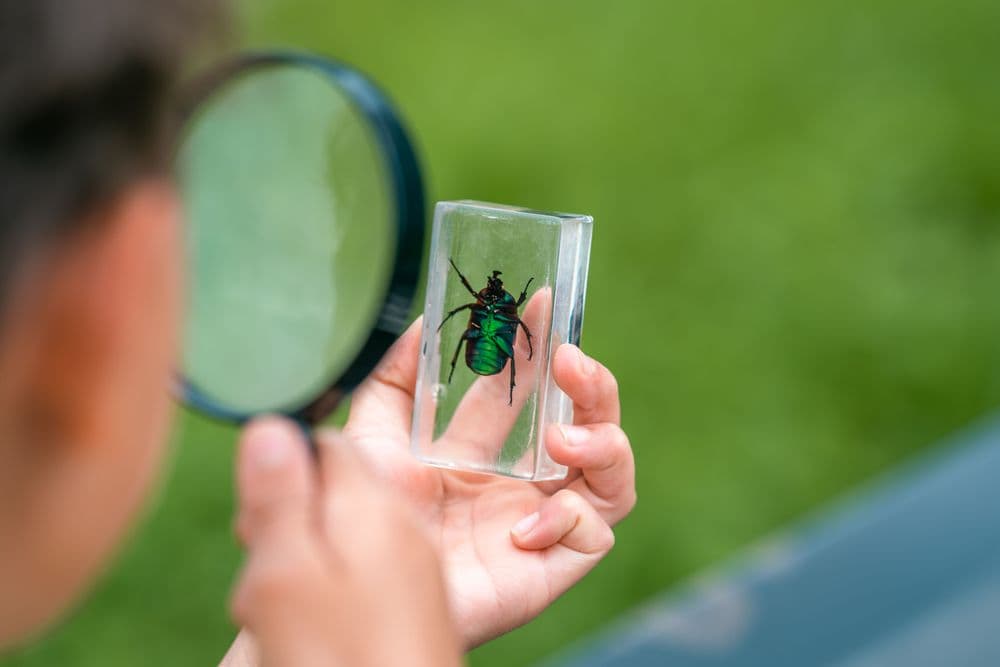
Occasionally, ground beetles or leaf beetles wander inside from gardens or lawns. Ground beetles are typically dark, fast-moving, and somewhat flattened with prominent jaws, while leaf beetles are often small, oval, and brightly colored or metallic. When these appear near doors, basements, or sliding windows, they are almost always incidental visitors rather than established indoor pests. In these cases, identification mainly serves to reassure you that a major infestation is unlikely.
Common Yard and Garden Beetles
Yard beetles are far more diverse than indoor species and range from important predators to foliage and root feeders. When identifying beetles outdoors, pay close attention to the type of plant or surface they occupy, the time of day they are active, and whether they are clustering or solitary. These details help you separate allies from potential garden pests.
Lady beetles, often called ladybugs, are among the easiest to recognize and are usually beneficial. Most species are small, dome-shaped beetles with bright red, orange, or yellow elytra and black spots, though some are black with red or orange spots. The familiar seven-spotted lady beetle, with its red back and three spots on each side plus one in the middle, is widespread. The multicolored Asian lady beetle varies more and can be orange, red, or even pale with many or few spots, and it has a light marking on the shield behind the head that resembles a “M” or “W.” Lady beetles cluster on plants infested with aphids or scale insects, and both larvae and adults feed on these pests.
Ground beetles are another common sight when you overturn stones, boards, or mulch. These beetles have elongated bodies, long legs, and are usually dark metallic or black with a somewhat flattened profile. Many species are fast runners and active at night, preying on caterpillars, other insects, and small soil invertebrates. Seeing ground beetles darting across patios or under outdoor lights at night is typical, and they are generally considered beneficial predators that help keep pest populations in check.
Leaf beetles and scarab beetles include many garden pests but also some neutral or beneficial species. Leaf beetles tend to be small, oval, and often brightly colored or metallic, feeding on specific host plants such as roses, willows, or vegetables. Their feeding creates characteristic shot holes or edge notches in leaves. Scarab beetles, including June beetles and chafers, are more robust and often brown or greenish, with sturdy legs adapted for digging. Adults may feed on foliage or flowers, while their larvae, called white grubs, live in soil and chew on grass roots, potentially thinning lawns. Recognizing these groups by their thick bodies and lamellate, fan-like antenna tips helps you distinguish them from slimmer, predatory beetles.
Some yard beetles turn up mainly because they are attracted to lights. Longhorn beetles, with very long antennae often as long as their bodies, may appear on porches in summer. Soldier beetles resemble narrow, soft-bodied fireflies but lack the glowing organ and often patrol flowers where they feed on nectar, pollen, and small prey. While these visitors may look alarming due to their size or color, many are harmless or helpful. Identification based on antenna length, body softness, and flower association can quickly rule out serious plant pests.
Conclusion
Learning to identify beetles around your home and yard is largely about connecting shape, color, and behavior with where you find them. Carpet and pantry beetles point to fabric or food problems, while wood-boring beetles signal issues with lumber or furniture. Outdoors, most beetles you notice are either predators or minor plant feeders, not threats to people. With a few visual cues and location clues, you can decide which beetles to ignore, which to encourage, and which require targeted control.
 X
X Facebook
 Telegram
 Instagram
 WhatsApp